Writing
Our Writing Curriculum
At our school, we aim for every child to become a confident, creative, and purposeful writer. Our writing curriculum is thoughtfully structured, research-informed, and designed to build strong skills gradually—while always keeping learning engaging and relevant.
Expertly Designed and Evidence-Informed
- Developed by Teresa Heathcote, a skilled Literacy Consultant, this teaching sequence has enhanced writing outcomes across schools using it.
- Writing units are planned over approximately two to three weeks and progressively build skills.
- It draws on the latest educational insights, including research from the Education Endowment Foundation and The English Education Report (2024).
Strong Foundations in Transcriptional Fluency
We place a key emphasis on transcription—handwriting and spelling—as a cornerstone of writing development:
- In line with the Department for Education’s 2025 Writing Framework, we teach handwriting and spelling explicitly from the early years, helping these skills become automatic.
- Daily practice and targeted support allow children to focus their energy on ideas and creativity instead of the mechanics of writing.
- Activities like dictation and oral rehearsal are used to strengthen fluency and help children embed their learning in meaningful ways.
- Across the school, we make reference to our "Ready to Write" routine which ensures children are physically in the best position to become a fluent writer.
The Writing Sequence: Step by Step (Year 2 Spring Term to Year 6)
Each writing unit follows a clear, supportive structure:
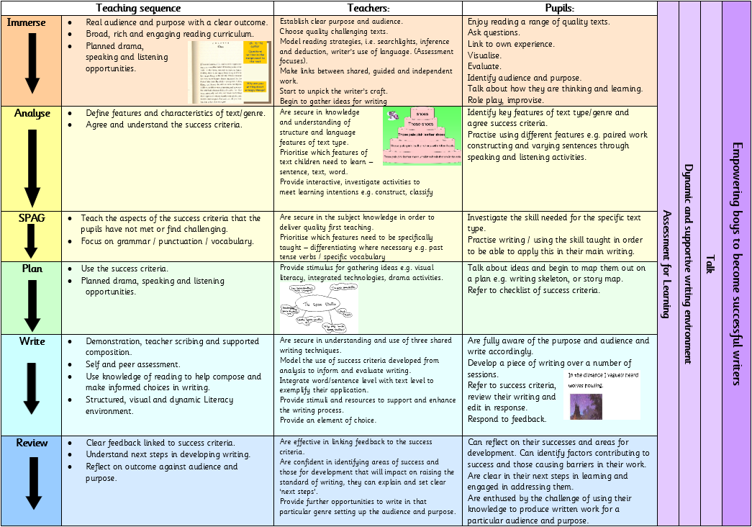
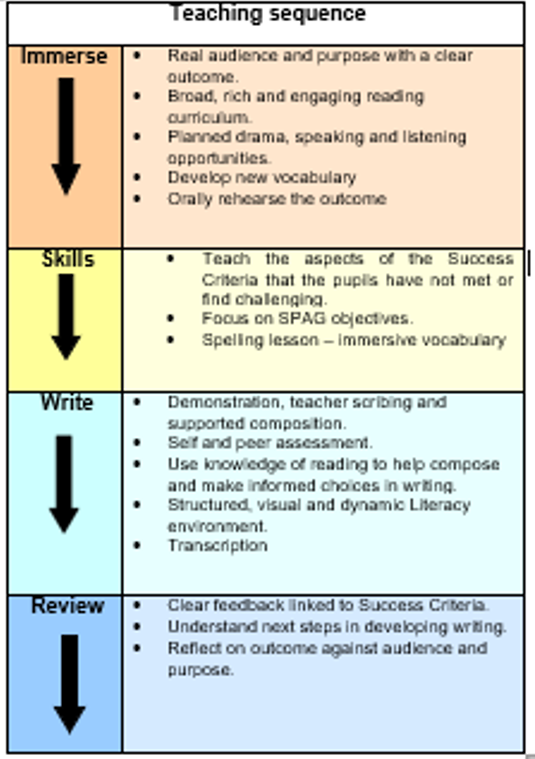
- Immersion – Students engage with rich texts, videos, drama, or storytelling to spark ideas and build vocabulary. We prioritise the acquisition of ambitious vocabulary driven by our "Language-driven" curriculum principle.
- Skills - SPaG (Spelling, Punctuation & Grammar) – Grammar and language skills are embedded in context, ready to be used naturally.
- Analysis – We examine high-quality writing samples to discover how authors make writing compelling and what their intended purpose for the reader is.
- Planning & Writing – Through modelling and guided support, children plan and draft their work in manageable stages.
- Editing & Improving – Real-time feedback and structured editing help students refine their writing.
- Publishing & Performing – Children share their polished pieces, often with real audiences, to give their writing purpose and pride.
Year 1 and Autumn Term Year 2 Writing Sequence is edited to:
To ensure that the content taught within each year group for similar genres is progressive, our KKPDs (Key Knowledge Progression Documents), Writing Subject Maps and the FHP Writing TAFs are used in the planning process.
Our approach to Handwriting
We follow the Nelson handwriting programme. Our approach to handwriting is built upon our "Ready to Write" routines and the need for teachers to have high expectations of themselves and their pupils.
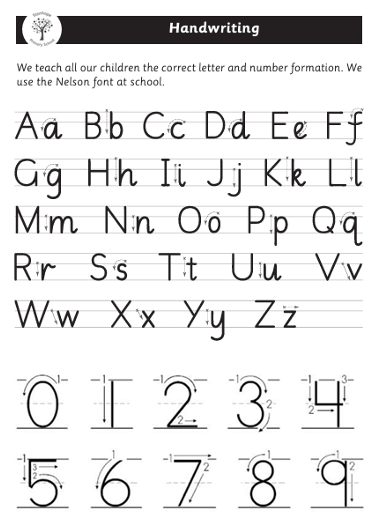
We want children to record their ideas accurately, efficiently and with increasing independence. When the physical and cognitive demands of writing become automatic, pupils can focus more of their attention on the content, organisation and quality of their writing. We are therefore keen to support children acquire transcriptional fluency in their writing.
Our approach to Spelling
Spelling at Stanhope is taught using the "Support for Spelling" programme. Children are encouraged to practice spellings at home throughout the week and we share how children are getting on with their spellings in our Reading Diary so parents can support school and vice versa.